Brushed Gold Flatware Review — Why Matte Beats Mirror Polish
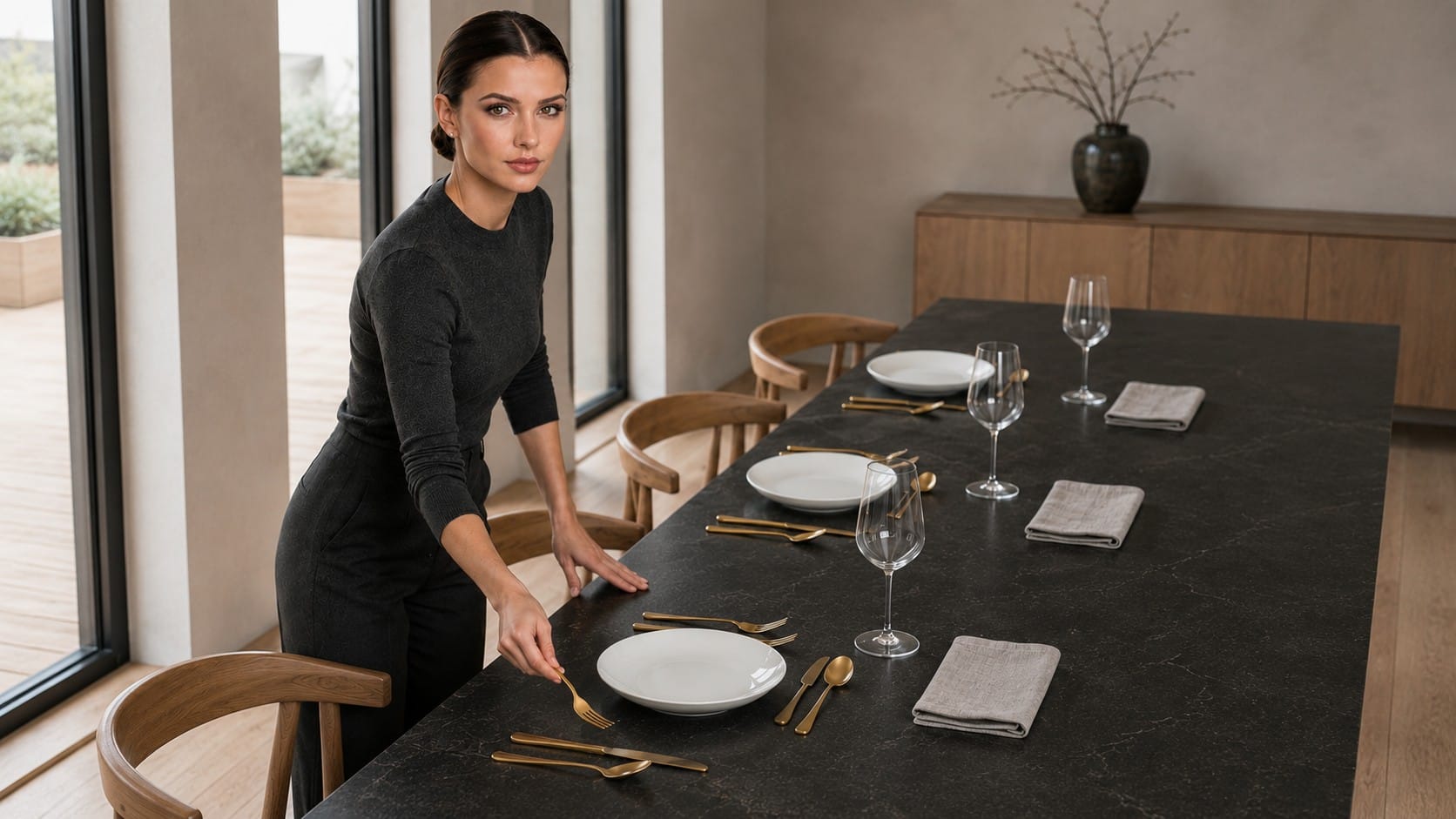
Twenty dollars for service for six, and the finish is the whole reason I chose this one. Matte or satin, never mirror-polish — high shine is the fastest way to make a restrained table look like a banquet hall.
✨ Key Features
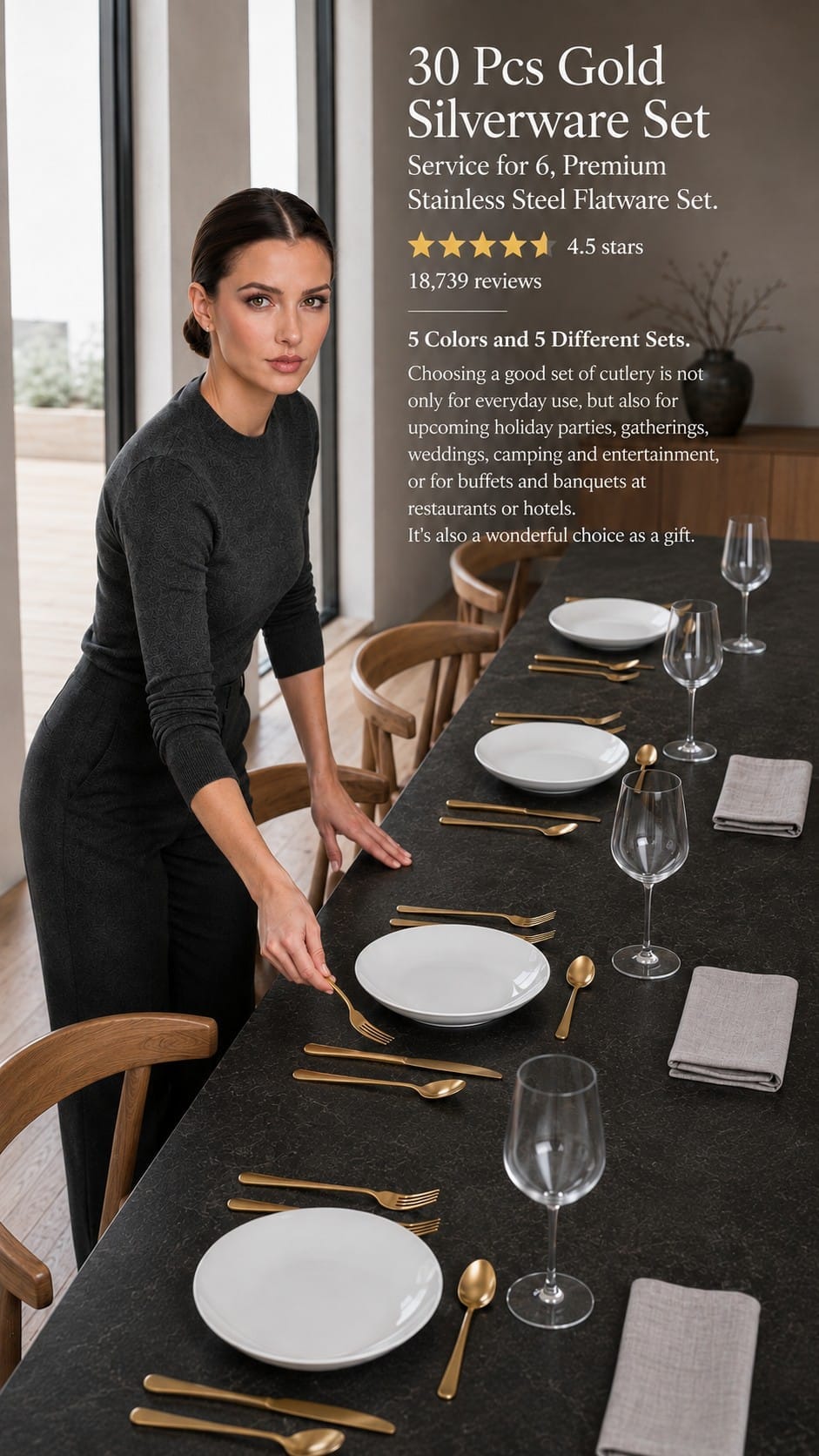
- 30 pieces, service for six — a complete five-piece setting each, no gaps to fill
- Stainless steel — the base material matters more than the finish on top of it
- 5 colourways — gold, black, silver and others if warm metal is not your palette
- The one warm note — on an all-neutral table this is where colour is allowed in
- 💰 $19.99 — about $3.30 a setting for something used at every meal
- ⭐ 4.5 stars, 18,739 reviews — one of the most-tested flatware sets on Amazon
✨ The quick verdict
Twenty dollars, eighteen thousand reviews, and the single most-touched object at any dinner you host. If you buy one thing off my table, this is the one where the price-to-use ratio is most obviously in your favour.
The finish is the decision
Mirror-polished flatware throws a hard specular highlight — a bright white point of reflected light — from every surface at every angle. Six settings of it means dozens of those points scattered across your table. Under candlelight it reads as busy, and in a photograph it blows out to pure white.
Brushed or satin metal has a microscopically textured surface, which scatters that reflection into a soft glow instead of a hard point. Same metal, same colour, completely different behaviour in light. It is the same principle as matte versus glossy paint, and it is why brushed reads expensive and mirror reads catering.
Where warm metal belongs on a neutral table
An all-neutral table has one structural risk, which is going flat. White on cream on greige with nothing to push against reads as unfinished rather than restrained.
The flatware is where I let warmth in. Not the plates, not the cloth, not the glassware — those stay quiet. One warm metal, repeated at every seat, does the whole job. And because it repeats six times down the table it reads as a deliberate scheme rather than an accent someone added at the end.
If you go gold here, keep the napkin rings gold too, and stop there. Two placements is a scheme. Four is a lot.
The honest part
- ⚠️ Coloured flatware is a coating over steel. It is not gold through and through at any price, let alone this one. Coatings wear at the contact points over years of use.
- ⚠️ Hand wash to make it last. Rated dishwasher safe, but detergent and heat are what shortens a coating’s life. Hand washing is the difference between a few years and a decade.
- ⚠️ Never leave it wet against stainless. Coated cutlery sitting damp in a drawer with bare steel is how spotting starts. Dry it before it goes away.
- ⚠️ Weight is modest at this price. It feels fine in the hand and it is not flimsy, but it will not have the heft of a set costing five times more. If weight matters to you, spend more and buy once.
- ⚠️ Service for six, exactly. No spares. If you regularly host eight, buy two sets now rather than trying to match a finish batch later.
Knowing all of it, I would still buy this. At twenty dollars the coating question is a reasonable trade.
Who it is for
This is for you if you want a warm metal on the table without committing several hundred dollars to finding out whether you like it. Twenty dollars is a genuinely low-risk way to test a whole aesthetic.
It is not for you if this is meant to be your only flatware for twenty years. Coated sets are not that. For that, buy plain stainless with weight and skip the colour entirely.
The bottom line
The most-touched object at your table, in the finish that behaves properly in candlelight, for twenty dollars across six settings. Hand wash it, dry it, and it will see you through a lot of dinners. ✨
Building the whole thing? Here is my full quiet luxury Christmas table → — every piece, top to bottom.






1 comment