The Lodi Matelassé Coverlet: Portuguese-Woven Cotton, and the Layer That Finishes a Bed

Pine Cone Hill Lodi Matelassé Coverlet — Alabaster, King → — our affiliate link; we earn a small commission at no cost to you.
⭐ 4.8 · 14 ratings on Amazon · $448 · 100% cotton · Woven in Portugal
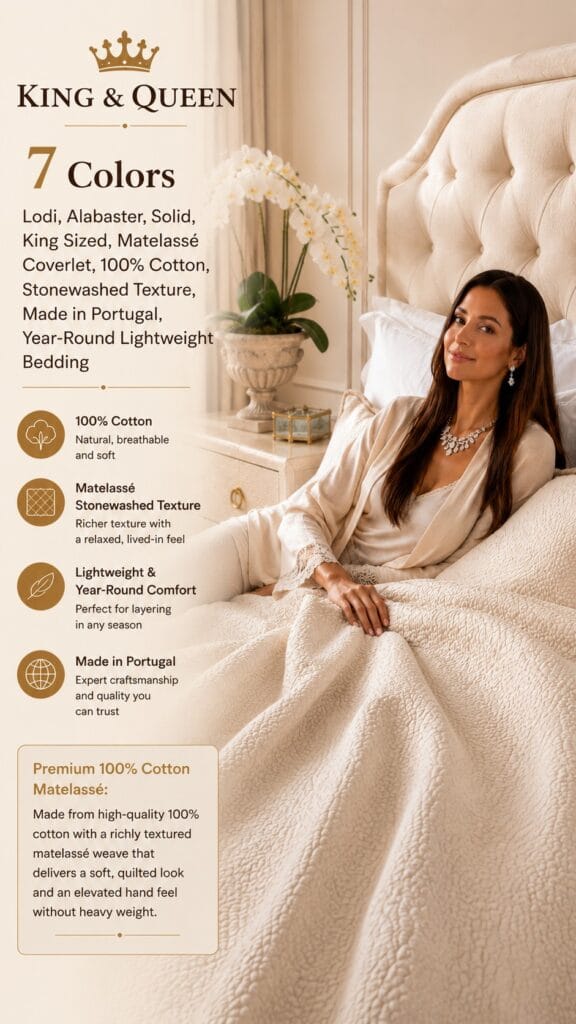
✨ Key Features
- 🧵 True matelassé, woven on a jacquard loom — two fabrics blended into one, giving the depth of quilting without a quilt’s bulk
- 🇵🇹 Made in Portugal — by weavers whose textile artistry is the reason luxury houses go there and nowhere else
- 🪨 Stonewashed and tumbled — that lived-in, buttery softness on day one, and it improves with every wash rather than degrading
- 🌗 Genuinely year-round — light enough to be the whole layer in July, substantial enough to sit under a duvet in January
- 🐾 Resists pet hair, snags, and pilling — the practical detail nobody mentions until their dog discovers the bed
- 🎨 Seven colorways — Alabaster, White, Sand, Sage, Silver, Blue Grey, and Black
Check the current price on Amazon →
The quick verdict: Beautiful beds are made of layers, and the layer most people are missing is this one — the coverlet that sits over the sheets, under the duvet, and does the quiet work of making a bed look finished rather than merely made. The Lodi is a genuine Portuguese-woven cotton matelassé, stonewashed to a softness that takes most linens years to earn. At $448 for a king it isn’t inexpensive, but it’s the piece you buy once. Worth it if you want a bed that looks considered rather than assembled.
There’s a difference between a bed that has been made and a bed that has been dressed, and most of us live our whole lives on the wrong side of it. A made bed has sheets pulled tight and a duvet thrown over. A dressed bed has layers — and layering is what gives a bed the depth and quiet richness you notice instantly in a beautifully done room without being able to name why.
The layer nearly everyone is missing is the coverlet. It goes over the sheets and under the duvet, and it does three things at once: it adds texture where a flat duvet has none, it gives you something to sleep under when a duvet is too much, and it makes the bed look composed rather than hastily assembled. The Lodi is the best version of that layer I’ve found at a price a real household might actually pay.
What matelassé actually is — and why it matters
The word gets used loosely, so it’s worth being precise, because the difference is what you’re paying for.
Matelassé is not a quilt. A quilt is layers of fabric stitched together with batting in between. Matelassé is woven on a jacquard loom; two fabrics are blended into a single cloth in a way that raises the surface and creates the impression of quilting without any stitching, batting, or seams at all. The texture is structural. It’s in the cloth, not applied to it.
This is why matelassé drapes the way it does — heavy and fluid at once, with none of the puffy stiffness of a quilt — and it’s why the texture will never come apart, flatten, or shift. There’s nothing to come apart. It’s one cloth, all the way through.
The Lodi is then stonewashed and tumbled, which is the step that separates good linens from merely expensive ones. Most cotton bedding arrives stiff and requires a year of washing before it earns the softness you were promised. Stonewashing does that work at the mill. It arrives already broken in, already relaxed, already the thing it’s meant to become.
Portugal, and the house behind it
Portuguese weavers are to textiles roughly what Japanese knifemakers are to steel: not a marketing detail, an actual reason. The country’s mills have a centuries-deep tradition in cotton and linen weaving, and the luxury houses that source there do so because the artistry genuinely isn’t replicable at scale elsewhere. When you see “Made in Portugal” on a coverlet, it means something specific — that it came off a real loom, in a place that has been doing this for generations.
And Pine Cone Hill is a genuinely good house. Annie Selke started it in 1994 with a sewing machine in her dining room. The company is headquartered in Pittsfield, Massachusetts, in a building constructed around an 1863 woolen mill — a mill that wove uniforms and blankets for Union soldiers during the Civil War. That’s not a story they invented for a catalogue; it’s the actual building. Selke studied textile science, and her work has been featured in shelter magazines for three decades and in the Obama White House.
I mention all of this because the Amazon listing shows 14 reviews, and I know exactly what that number does to a modern shopper’s instincts. Here’s the honest framing: this is a small-batch product from a design house that sells primarily through its own stores, interior designers, and specialty retailers. It will never accumulate the tens of thousands of reviews a mass-market microfiber coverlet does — not because it’s unproven, but because that isn’t the business it’s in. The mill, the loom, the country, and the thirty-year house are the proof. The star count is a rounding error.
The honest part
$448 for a king is a real number, and I won’t pretend otherwise. This is a considered purchase, not a refresh. If your budget for a bedding layer is under a hundred dollars, there are perfectly decent cotton coverlets that will look fine from across the room — and you should buy one of those and spend the difference elsewhere. The Lodi is for the person who wants the right one and intends to keep it.
It is a coverlet, not a comforter. In a genuinely cold house, in deep winter, this alone will not be enough — it’s designed to be a layer, not the layer. Pair it with a duvet in January. If you want a single bedding item that does everything, this isn’t it, and it isn’t trying to be.
The alabaster is a warm off-white, not a crisp bright white. It’s lovely, and it plays beautifully with cream, linen, and natural wood. But if your bedroom is built around a cool, snow-white palette, order the White, not the Alabaster — the two are genuinely different, and photographs on any listing will not tell you that.
And it’s cotton, so it wrinkles. It’s meant to look relaxed — that’s the entire aesthetic of a stonewashed textile — but if you need bedding that lies perfectly flat and knife-crisp, this will read as rumpled to you rather than as lived-in. Know which of those two people you are before you buy.
Who it’s for — and why guest rooms are the quiet argument
The person finishing a bedroom properly, who has already bought the good sheets, and can feel that something is still missing. It’s for the reader who understands that texture is what makes a room feel expensive, and that flat surfaces — however costly — always read as flat.
And it’s for anyone dressing more than one bed. This is where the Lodi becomes a genuinely different conversation. Seven colorways means a primary bedroom, two guest rooms, and a child’s room can all be dressed in the same coverlet, in different tones, and the whole house will read as one coherent, intentional scheme rather than four rooms decorated at different times by different moods. If you host — and if you’re reading me, you probably do — a guest room dressed to the same standard as your own is the single most gracious thing you can do for someone before they’ve even set down their bag. Buy two. Buy four. This is a piece that rewards being bought in multiples.
The bottom line
The Lodi Matelassé is the layer that turns a made bed into a dressed one. It’s real Portuguese weaving, real cotton, stonewashed to a softness most linens take years to reach, from a house that has been doing this thoughtfully since 1994. It costs what a well-made thing costs, and it will look better in five years than it does the day it arrives.
Ignore the fourteen reviews. Buy the alabaster if your room is warm, the white if it’s cool, and buy a second one for the guest room while you’re at it — the version of you who has people staying next month will be grateful.
Check the current price on Amazon →
See the full Luxury Bedding edit →
As an Amazon Associate, SparkTrove Trends earns from qualifying purchases — at no additional cost to you.
I love you all — stay sparkly and stay luxurious. Luxe Lexi for SparkTrove Trends. 🤍






1 comment