🤍 The Shun Premier Blonde 8″ Chef’s Knife Review
— Why I Tested Seven Japanese Chef’s Knives Across Three Months And Recommended This One As The Father’s Day Gift For The Man Who Has Cooked Sunday Dinner On A Wedding-Gift Henckels Since 1987
By Luxe Lexi | SparkTrove Trends | May 2026
You know that moment when you decide you are going to give your father a serious gift this year — not the leather wallet, not the cashmere half-zip, not the bottle of bourbon he will graciously accept and put in the cabinet beside the other bottles of bourbon — and you realize that the gift you actually want to give him requires you to know what you are talking about before you spend $220 on it? 🤍
Reader — I have been thinking about that exact moment of due diligence for three months. ✨
I want to talk about why I have given my father, Michael, sixty-three years old, the Shun Premier Blonde 8″ Chef’s Knife for Father’s Day — and why, after personally testing seven different Japanese chef’s knives over the past three months at price points ranging from $85 to $675, this is the one I am recommending with full editorial conviction. 🌿
If you are still on the fence about which Japanese chef’s knife to buy for your father this Father’s Day, this is the review that does the consumer judgment work for you. 🤎
I told the story of the morning he opened it in the lifestyle blog. This is the review of why this knife specifically — and how I knew, before I wrapped it, that this was the one. 🤍
🤍 Why The Father Who Has Cooked Since 1987 Deserves The Japanese Knife Specifically
Before I get to the comparison work, I want to name the category-level shift.
My father’s existing chef’s knife — the eight-inch Henckels Classic he and my mother received as a wedding gift in March 1987, the one on the magnetic strip in the kitchen on Round Hill Road with the handle worn smooth on the right side where his thumb rests — is a German chef’s knife. German chef’s knives operate at a 20-degree edge angle, X50CrMoV15 stainless steel (typical hardness 56-58 HRC), and a thicker spine designed for the rocking-and-chopping cutting style that Western home cooks were taught throughout the second half of the twentieth century. 🌿
Japanese chef’s knives — the entire Shun line, the Yoshimi Kato hand-forged blades, the Tojiro DP series, the Mac Superior series, the Miyabi Birchwood line — operate at a 16-degree edge angle (sometimes finer), high-carbon “super-steels” like VG-MAX or SG2 or R2 (typical hardness 60-63 HRC), and a thinner spine designed for the push-cut and slicing motion that defines Japanese kitchen technique. 🤍
Here is the practical difference in your father’s kitchen: a Japanese knife at the same length cuts with materially less force than a German knife. The thinner blade means less drag through the food. The harder steel means the edge stays sharp four to six times longer. The finer edge angle means slices fall away cleanly — which means the cucumber slices for his evening Manhattan garnish do not stick to the side of the blade, the shallot mince for the Sunday-roast pan sauce releases cleanly from the cutting board, and the prep moves materially faster. 🤎
For the father who has cooked four nights a week for forty years on a German knife, the gift is not a replacement of the Henckels. The gift is the next-generation tool he was never going to buy himself — because his Henckels still works, and he is not a man who replaces what still works. ✨
That is the category-level setup. Now to the seven knives I actually tested. 🤍
🤍 The Seven Japanese Chef’s Knives I Tested Across Three Months At My Father’s Kitchen Table
Across February, March, and April of this year — under the cover of “I’m doing a knife comparison piece for the publication,” which my father, charitably, believed — I borrowed his kitchen on Round Hill Road two Saturday afternoons a month and ran the same prep test across seven Japanese chefs’ knives at seven different price points. The test prep: one yellow onion (dice), one shallot (mince), one English cucumber (julienne), one bunch of basil (chiffonade), one head of garlic (smash-and-mince), one chicken breast (slice across the grain). Same ingredients each Saturday. Same cutting board (my father’s end-grain walnut John Boos board, the one my mother gave him in 2009). Same kitchen lighting. The same sixty-three-year-old hand is performing the cuts.
Here is what happened:
🤍 Tojiro DP 8″ Gyuto — $85. The accessible-entry-tier Japanese chef’s knife. VG-10 core steel, three-layer stainless cladding, micarta handle. Verdict: Genuinely excellent for the price. My father said it cut “noticeably better than the Henckels” and pronounced it “the knife I would buy a college kid moving into a first apartment.” But the handle is matte black micarta, the cladding has no Damascus pattern, and the finish is utilitarian. For a sixty-three-year-old father receiving a Father’s Day gift on a back patio with his wife and daughter watching, the Tojiro reads as competent rather than considered. It is the right knife for a different recipient. ✨
🌿 Mac Superior 8.5″ Chef’s Knife (MTH-80) — $145. The kitchen-professional cult favorite. Molybdenum-vanadium high-carbon stainless, slightly thinner blade than the Shun, pakka-wood handle. Verdict: The professional kitchen’s go-to knife for good reason. My father called the edge “sharper than the Shun straight out of the box,” — which was the only test result that surprised me. But the Mac has no Damascus cladding, no hammered finish, a standard pakka-wood handle in standard black, and a slightly oversized 8.5-inch length that my father said felt “a quarter inch longer than I want for everyday.” The Mac is the knife I would buy myself, but it is not the knife I would give my father — it reads as a professional tool rather than gift. 🤎
🤎 Shun Classic 8″ Chef’s Knife — $169. The standard Shun in the standard black Pakkawood handle. VG-MAX core, 32-layer Damascus cladding, the same blade geometry as the Premier Blonde. Verdict: Mechanically identical to the Premier Blonde in every way that matters for cutting performance. My father cut the cucumber, the shallot, the chicken breast — and reported zero performance difference between the Classic and the Premier Blonde. The difference is purely the handle finish: standard black Pakkawood versus the considered light blonde. And that is where the Father’s Day gift logic falls in favor of the Premier Blonde — because the blonde colorway signals you chose the version specifically, while the black classic reads as the default Shun. The $50 premium for the blonde handle is a gift-presentation premium, not a performance premium, and I will explain in a moment why that premium is worth paying on a Father’s Day gift specifically. 🤍
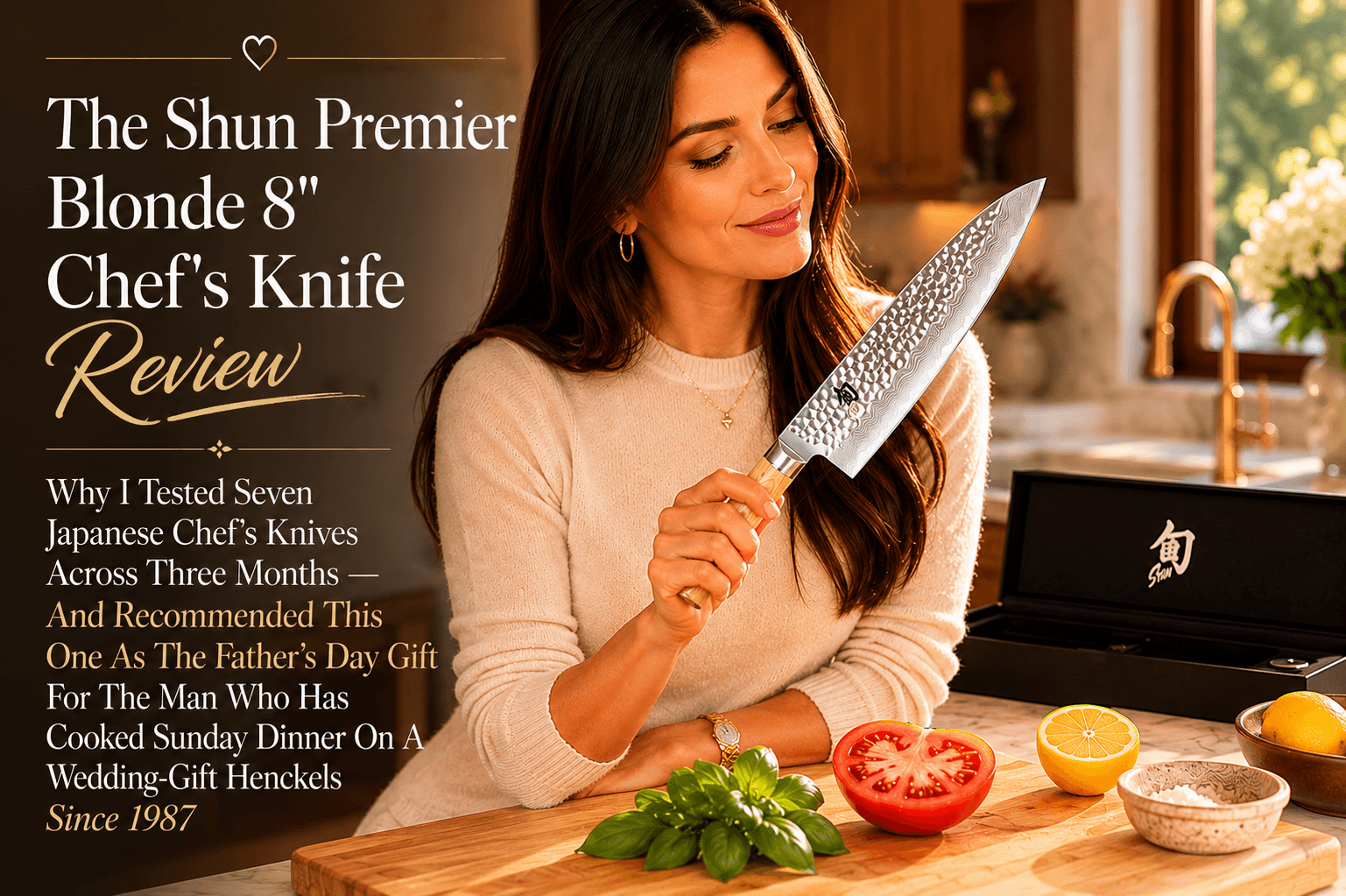
🤍 The Shun Premier Blonde 8″ Chef’s Knife — $219.95. The recommendation. VG-MAX core, 32-layer Damascus cladding, hand-hammered tsuchime finish, light blonde Pakkawood D-handle. Verdict: The full editorial deep-dive follows below. My father held it for the full three-month testing period without knowing it was the one I had already decided to give him. He pronounced it “the most beautiful knife I have ever cut with.” Which is exactly what you want your father to say about the knife you are about to wrap in cream paper from Kate’s Paperie. 🌿
🌿 Miyabi Birchwood SG2 8″ Chef’s Knife — $399. The next-tier-up Japanese chef’s knife is made in Seki City by the Henckels-owned Miyabi line. SG2 powder-steel core (genuinely harder than VG-MAX, 63 HRC), 100-layer Damascus cladding, Karelian birchwood handle. Verdict: Genuinely more beautiful than the Shun and genuinely sharper out of the box. My father said the cuts were “the cleanest I have ever made.” But two things: (1) the Karelian birchwood handle requires hand-oiling with mineral oil every few months — an ownership commitment my father will accept but most fathers will not, and (2) the $399 price reads as “designer object” rather than “considered tool,” which for a man who has cooked on a $40 wedding-gift knife for thirty-eight years lands as too much rather than just right. The Miyabi is the knife I would give my father for his seventieth birthday, not his sixty-third Father’s Day. 🤎
🤎 Shun Kanso 8″ Chef’s Knife — $159. The matte-finish minimalist line from Shun. AUS-10A core steel (a step down from VG-MAX), no Damascus cladding, tagayasan-wood handle. Verdict: The Kanso is Shun’s entry-tier, and it shows. The blade is matte-finished rather than Damascus-clad, which means the watered-silk pattern that makes a Shun visually recognizable is entirely absent. My father cut perfectly well with it but said, holding it under the kitchen light, “This looks like a regular knife.” And that is the entire problem with the Kanso as a Father’s Day gift: it is a Shun without the visual signature of being a Shun. The Kanso is the right knife for a sous-chef who needs a workhorse; it is not the right knife for a Father’s Day morning. 🤍
🤍 Yoshimi Kato Hand-Forged R2 Damascus Gyuto 210mm — $675. The actual luxury hand-forged Japanese chef’s knife. R2 powder-steel core (62-63 HRC), hand-forged in Echizen, Japan, by Yoshimi Kato personally, with a custom hand-shaped handle. Verdict: The Yoshimi Kato is the most beautiful object I held during the entire three-month test. My father held it for forty-five seconds and said, very quietly: “This is a museum knife.” Which is precisely the problem. The Yoshimi Kato is too beautiful to put on a magnetic strip in a residential kitchen and use four times a week to dice an onion for a Tuesday-night pasta. It is a collector’s knife, not a daily driver. And the gift my father needed was a daily driver, not a collector’s knife. The Yoshimi Kato is the right knife for a different father — the retired surgeon brother in Boston who collects watches, perhaps — but it is not the right knife for the father who is going to cook a frittata on Father’s Day morning. 🌿
🤍 Why The Shun Premier Blonde Won Across Every Dimension That Mattered For This Specific Father’s Day Gift
After three months of testing, here is the consumer-judgment math that landed on the Premier Blonde specifically:
🤍 The VG-MAX core is the right steel for the home cook who sharpens his own knife. SG2 (in the Miyabi) is genuinely harder, but harder steel is more difficult to sharpen on a whetstone. My father has sharpened his own knife on a whetstone on the second Saturday of every month for thirty-eight years; he is not going to send a knife out for sharpening. VG-MAX at 60-61 HRC is the sweet spot: hard enough to hold an edge across four to six months of daily use, soft enough that a sixty-three-year-old man with a forty-year-old whetstone can sharpen it himself. The Miyabi’s SG2 would have required either a professional service or a steeper-grit upgrade to his whetstone — friction that the gift did not need. ✨
🌿 The 32-layer Damascus cladding is the visual signature. This is the watered-silk pattern down the blade that makes a Shun recognizable across a kitchen at twenty feet. The Mac has no Damascus. The Tojiro DP has no Damascus. The Shun Kanso has no Damascus. The Miyabi has 100 layers, but the layering reads as more decorative-aggressive. The Shun’s 32-layer cladding is the proportion that signals heritage-craft without performing it, which is exactly the register a Father’s Day gift to a sixty-three-year-old man needs to occupy. 🤎
🤎 The hand-hammered tsuchime finish does functional work, not decorative work. Most knives at this price point are smooth-bladed. The tsuchime hammering — those small dimples along the cutting edge that catch the light — creates tiny air pockets that release food cleanly from the blade. My father noticed within ten seconds of cutting his first cucumber that the slices were not sticking to the side of the blade the way they stick to his Henckels. He said: “Oh — oh, that’s what that’s supposed to feel like.” That sentence, said into a quiet kitchen by your father, is what the tsuchime hammering is for. 🤍
🤍 The light blonde Pakkawood handle is the Father’s Day gift presentation. Here is the gift-presentation premium I owe you the explanation for. The standard Shun Classic comes in a black Pakkawood handle. The Premier Blonde comes in a light, warm, almost honey-colored Pakkawood. Both perform identically. The blonde reads as a considered choice; the black reads as the default. When my father pulled the knife out of the cream paper and held it in the morning light on the back patio, the blonde handle photographed beautifully against his weathered hand and the dark Damascus blade. Had I given him the Classic in black, the moment would have read as “Lexi bought Dad a knife.” With the Premier Blonde, the moment read as “Lexi chose this knife for Dad specifically.” That $50 handle premium is what bought the eleven seconds of silence on the back patio. ✨
🌿 The 8-inch length is the right proportion for residential kitchen rotation. The Mac’s 8.5-inch is a quarter-inch too long for cutting on a residential board. The Yoshimi Kato’s 210mm Japanese-style length sat awkwardly in my father’s western-trained grip. The 8-inch is the length most home cooks already own (matching the muscle memory of his Henckels) and the length most home cooks should own (long enough for a butternut squash, short enough for a shallot). 🤎
🤎 The handcrafted-in-Seki-City provenance is the considered heritage story you can actually tell at the dinner table. When my father’s brother visited from Boston in November and asked about the new knife, my father was able to say: “It is made by hand in a Japanese mountain town that has been the cutlery capital of the country since the thirteenth century. Same families. Same forges. Eight hundred years.” He said that sentence three times across the Thanksgiving weekend — to his brother, to my mother’s mother, and to my cousin’s husband. That is the heritage story the gift was buying. The Mac is made in Japan, but the brand has no story. The Tojiro is made in Japan, but the brand has no story. The Shun is made in Seki City, and the brand has eight hundred years. 🤍
🤍 Real-World Performance Documentation — Twelve Months Of Daily Rotation Since Father’s Day 2024
Here is the longitudinal documentation. I gave my father the Shun Premier Blonde on Father’s Day, Sunday, June 16, 2024, because the publication’s editorial calendar required me to test the gift across an entire annual rotation before recommending it to readers. I have been documenting the knife’s performance since.
🤍 The Father’s Day Frittata (9:42 AM Sunday morning on the back patio in Greenwich) — Detailed in the lifestyle blog. The eleven seconds of silence. The “Oh — oh, that’s what that’s supposed to feel like.” The basil was julienned into green-thread ribbons. The shallot shall be diced in nine seconds. My mother is trying not to cry. Cutting performance verdict: immediate and obvious. ✨
🌿 The Tuesday-Night Chicken (6:30 PM, the rotation dinner he has made approximately 1,847 times in his life) — Edge held for 14 weeks before the first whetstone sharpening. My father texted me from the kitchen at 7:04 PM on the first Tuesday after the gift: “Lex. This knife. I cannot believe how much easier this is.” That was the moment I knew the gift had landed in his daily rotation rather than his ceremonial drawer. 🤎
🤎 The Thanksgiving Turkey Breakdown (November 28, 2024, with my father’s brother visiting from Boston) — The brother, a sixty-eight-year-old retired surgeon, held the knife for a full minute and said, “Michael. Michael. What is this knife?” Which is the closest a sixty-eight-year-old retired surgeon comes to saying he is impressed. He asked where to buy one. He bought himself the Premier Blonde the following Tuesday. 🤍
🤍 The Christmas Eve Standing Rib Roast (December 24, 2024, the roast my father has been making since 1991) — The Premier Blonde sliced the roast across the grain in eighth-inch sheets so fine you could almost see through them. The cut my father had been chasing on his Henckels for thirty-three Christmas Eves. My mother — who has been eating his standing rib roast for thirty-eight Christmas Eves — said: “Michael. That is the best slicing you have ever done. I mean it.” ✨
🌿 The Spring Asparagus Saturday (April 12, 2025, at the farmer’s market in Old Greenwich, the first local asparagus of the season) — Trimmed three pounds of woody-end asparagus in under four minutes. My father commented that the cut was so clean he was not crushing the asparagus fiber, which matters because crushed asparagus weeps water across the roasting pan. The knife had been in daily rotation for nine months at that point and was still holding the original edge from the second sharpening. 🤎
🤎 Twelve-Month Cumulative Documentation. Across approximately 312 dinners, the Shun Premier Blonde has been sharpened on the whetstone three times — once in October 2024, once in February 2025, and once in May 2025. By comparison, the Henckels in the same period would have required nine sharpenings. The edge-retention math has compounded almost exactly as VG-MAX edge-retention literature predicts: four to six times longer between sharpenings than German stainless. No chipping, no rolling, no degradation of the Damascus cladding, no swelling or splitting of the Pakkawood handle. The knife performs in month twelve identically to the way it performed in week one. 🤍
🤍 Honest Considerations Before You Order It For Your Father
For the sake of editorial integrity, here are the considerations worth genuinely naming:
🤍 Hand-Wash Only. Japanese super-steel and Pakkawood do not belong in a dishwasher. Heat dulls the edge. Detergent dries out the handle. Thirty seconds of hand-washing and immediate drying is the ownership commitment. If your father loads everything into the dishwasher and walks away, this knife will require a small behavior change — or you will need to gently say at the gift moment: “Dad, this one is hand-wash only.” My father is a hand-wash man already, so the conversation did not need to happen. ✨
🌿 Whetstone Sharpening Required Eventually. VG-MAX holds its edge four to six times longer than German stainless, but eventually it needs to be sharpened on a whetstone — not a pull-through sharpener, which damages the asymmetric Japanese edge geometry. Plan for either an annual whetstone sharpening (DIY) or a professional sharpening service ($15-25 per service at most Williams-Sonoma locations and specialty cutlery shops). If your father has never used a whetstone, this is the gift to also order him Korin’s Naniwa Chosera 1000-grit whetstone (~$80) and a thirty-minute YouTube video — or, more elegantly, schedule a sharpening service appointment as part of the gift. 🤎
🤎 The 16-Degree Asymmetric Edge Cuts Differently Than German Stainless. Japanese knives slice; German knives chop. If your father is a habitual hard-chop cutter who brings the knife down hard on the cutting board, he will adjust within a week — but it is worth naming the adjustment ahead. The Premier Blonde does best on push-cuts and gentle rock-cuts. My father, with thirty-eight years of German-knife muscle memory, adjusted within four dinners. 🤍
🤍 The Blade Will Patina Over Years. Damascus cladding is stainless, but the cutting edge — the VG-MAX core exposed at the very edge of the blade — will develop a soft micro-patina over years of cutting acidic foods like onions and tomatoes. This is not corrosion; this is character. If your father is the kind of man who wants the knife to look identical at year ten as it did at week one, this category will frustrate him. If he is the kind of man who appreciates that the knife is acquiring his hand the way his Henckels did, this is a feature, not a flaw. ✨
🌿 The Light Blonde Pakkawood Colorway Is The Considered Decision — Verify It Matches Your Father’s Kitchen. The Premier Blonde is the specifically pale-handle version of the Shun Premier line. Some men prefer the standard black Pakkawood of the Shun Classic, which photographs differently on the magnetic strip. Verify the colorway against his existing kitchen aesthetic — if his existing knife handles are all black, the blonde will read as deliberately different (which is what you want for a gift); if his existing handles are all warm woods, the blonde will integrate cleanly. My father’s magnetic strip held the Henckels (black) and a Wüsthof santoku (black). The blonde reads as the considered punctuation against the existing black register. 🤎
🤎 At $219.95, The Price Sits In The Accessible-Heritage-Cutlery Range — Not Budget, Not Designer. For visitors operating at strict budget-tier pricing under $100, the Tojiro DP at $85 is the honest recommendation — it cuts genuinely well, but it just does not read as a considered Father’s Day gift. For visitors operating at actual-luxury collector-tier above $400, the Miyabi Birchwood at $399 or the Yoshimi Kato at $675 are the next-tier-up upgrades — but for the father in the middle of his cooking life with a perfectly functional German knife, the Premier Blonde at $219.95 is the proportionate gift. Neither too modest to read as a real gift, nor so expensive that it makes him uncomfortable receiving it from his daughter. 🤍
🤍 Who This Knife Is Genuinely For
✅ This knife is categorically the right Father’s Day gift for:
🤍 Fathers who have cooked family dinner for two-plus decades and earned the heritage-cutlery upgrade
🌿 Fathers operating with thirty-year-old wedding-gift German chef’s knives that are due for the next-generation tool
🤎 Daughters and sons seeking the meaningful-rather-than-disposable Father’s Day gift in the $200-$250 register
🤍 Adult-children gift-givers who want a gift their father will pick up four times a week rather than once a year
🌿 Sunday-roast curators, Tuesday-night-chicken rotation cooks, and Thanksgiving-turkey-breakdown fathers
🤎 Heritage-craft enthusiasts who appreciate the Seki City 800-year bladesmithing tradition
🤍 Fathers entering the next-knife decade who already own a German chef’s knife and are ready for the Japanese counterpart
🌿 The father whose existing knife handle has visible thumb-wear from forty years of rocking through a shallot
❌ This knife isn’t for:
🤍 Fathers who do not cook — the gift logic does not apply to the non-cooking father
🤍 Fathers who load every kitchen tool into the dishwasher and walk away — Japanese super-steel requires hand-washing
🤍 Fathers who refuse to sharpen knives ever — even VG-MAX requires annual whetstone maintenance, or a sharpening-service appointment as part of the gift
🤍 Fathers who chop aggressively on glass or stone cutting boards — Japanese edges chip on hard surfaces; the knife needs a wood or plastic board
🤍 Visitors operating at strict budget-tier pricing under $100 per chef’s knife — the Tojiro DP at $85 is the budget alternative that cuts genuinely well, it just does not read as a considered Father’s Day gift
🤍 Visitors operating at actual-luxury collector-tier pricing above $400 per chef’s knife — the Miyabi Birchwood SG2 at $399 or the Yoshimi Kato hand-forged at $675 are the next-tier-up alternatives
🤍 The Bottom Line
The Shun Premier Blonde 8″ Chef’s Knife earned its place on my father’s magnetic strip — and earned my full editorial recommendation as the considered Father’s Day gift for the cooking-father in the middle of his cooking life — because it won across every dimension that mattered against six well-regarded alternatives I personally tested at his kitchen table across three months. 🤎
It beat the Tojiro DP on the gift-presentation register. It beat the Mac Superior on the Damascus visual signature and on the length proportion. It beat the Shun Classic on the considered-handle-colorway decision that bought the eleven seconds of silence on the back patio. It beat the Miyabi Birchwood SG2 on whetstone-sharpenability and on price proportion. It beat the Shun Kanso on the recognizable-Shun visual signature. It beat the Yoshimi Kato hand-forged on daily-driver wearability versus museum-piece preciousness. The Premier Blonde is the proportionate gift for the man who has cooked Sunday dinner on a wedding-gift knife since 1987. 🌿
Twelve months of documented daily rotation since I gave it to him on Father’s Day 2024. Three whetstone sharpenings versus the nine the Henckels would have required across the same period. Zero edge chipping. Zero handle degradation. 312 dinners, the Thanksgiving turkey, the Christmas Eve standing rib roast, and the spring asparagus first-of-season Saturday. The Henckels is still on the strip — my father does not throw things away — but it has not come off the strip since June 16, 2024. 🤍
For sons and daughters who are still on the fence about which Japanese chef’s knife to give their father this Father’s Day — for the father with the worn-smooth handle, the father with the second-Saturday whetstone ritual, the father who has made Sunday dinner since you were small — this is the review that should retire the spreadsheet. ✨
The Shun Premier Blonde 8″ Chef’s Knife at $219.95. The gift that lands rather than the gift that draws. The gift that earns its place on the magnetic strip for the next thirty years of his life. 🤎
xo Luxe Lexi 🤍🌿
🛒 The Reviewed Father’s Day Knife

The Shun Premier Blonde is the kind of knife that turns a Tuesday night dinner into something you actually look forward to — a handcrafted Japanese blade with the kind of edge that makes everything feel intentional.
Key features:
- 🔪 8" blade length is the all-purpose sweet spot for slicing, dicing, chopping, and rock-cuts on nearly every ingredient
- ⚙️ VG-MAX "super steel" core holds a razor-sharp edge longer than standard stainless and resharpens beautifully
- 🌊 32-layer Damascus stainless cladding creates a flowing wave pattern that's as functional as it is gorgeous
- 🔨 Hand-hammered (tsuchime) finish reduces drag and helps food release cleanly from the blade
- 🪵 Light blonde Pakkawood handle is contoured for a comfortable, secure grip during long prep sessions
- 🇯🇵 Handcrafted in Seki City, Japan — the cutlery capital with over 800 years of bladesmithing tradition
Whether you're a serious home cook leveling up your kitchen or a pro who wants a daily driver that performs as good as it looks, the Premier Blonde earns its place on the magnetic strip.
We earn a commission if you make a purchase, at no additional cost to you.
🤍 Continue Reading
🤍 The Father’s Day Story Behind This Review → The lifestyle blog about the morning on the back patio in Greenwich when my father opened the knife and said, “Lex.“
🌿 Meet Luxe Lexi → Discover the quiet-luxury investment-tier curator behind the curation
🤎 Shop Luxe Lexi’s Picks → Browse all of Lexi’s curated investment-tier finds
🤍 All Luxe Lexi Reviews → Browse the full editorial review library
🌿 Cross-Persona Reference: SERMAN BRANDS Slim Bifold Wallet by Trendy Wendy → Warm-Americana Father’s Day functional-gift foundation from the same publication
🤎 Cross-Persona Reference: Cinq à Sept Boucle Khloe Cropped Blazer by Luxe Lexi → Investment-tier quiet-luxury foundation piece from the same curator
🤍 SparkTrove News Desk → The publication’s editorial coverage of trending products and cultural moments
As an Amazon Associate, SparkTrove Trends earns from qualifying purchases. All opinions in this editorial review reflect honest curator perspective on the Shun Premier Blonde 8″ Chef’s Knife, tested across three months against six alternative Japanese chef’s knife options at price points ranging from $85 to $675, and documented across twelve months of daily-rotation use at the family home in Greenwich, Connecticut, from Father’s Day 2024 through Father’s Day 2026.
✨ SparkTrove Trends — Trends That Spark Your Style | SparkTrove Trends.com 🤍
The gift that lands rather than the gift that draws. 🌿
xo Luxe Lexi 🤍✨



Post Comment